All Posts

Rabbi Steven Moskowitz Rabbi Steven Moskowitz

Obama and the Muslim World

I have been meaning to write for some time about President Obama's speech in Cairo and his trip to the Arab world the first week of June. First, a brief moment of relish. For me one of the most remarkable photos was that of Obama sitting to the left of Saudi Arabia's King Abdullah and to his right, Rahm Emanuel. I know Emanuel no longer lives in Israel. He is instead the White House chief of staff. Still you have to smile when you think about the symbolism of a Jew (and an Israeli) sitting next to Saudi Arabia's king...
Regarding President Obama's speech there is much to be said. There are positives and there are negatives. Let us first say loud and clear that Obama deserves enormous credit for traveling to the heart of Islam and speaking there words of passion and truth. Saying here is far less important than saying there words such as these. "The sooner the extremists are isolated and unwelcome in Muslim communities, the sooner we will all be safer." President Bush rightly saw the world in clear, bold lines between good and evil, friend and enemy. Let us not be naive. We have enemies. Yet how we see the world is not always how we should deal with the world and so a new strategy was required. We do not know yet if Obama's new approach will produce positive results, but if the elections in Lebanon and the simmering of revolt in Iran are measures then we can allow ourselves to be cautiously optimistic. Where the speech failed was in its treatment of Israel. It was not that he called for a Palestinian state or even in the abandonment of settlements (although I would qualify settlements to include only isolated settlements--both geographically and ideologically). My disappointment was instead in his misunderstanding of Zionism. President Obama spoke of Jewish suffering as that which lends legitimacy to the modern State of Israel. I wish Emanuel had whispered in his ear the following: It is also the United Nations (remember the vote on Partition), the Bible, Jewish history, the Hebrew language. It is the fact Jewish life begins and ends in Jerusalem and the land of Israel. It has always been our focus. It was once our dream. Now it is our reality. Despite these misgivings I conclude with our prayers who wrap words of hopes in the stones of Jerusalem. Words can change worlds. Words can move mountains. Peace begins with the word shalom echoing forth from the land of Israel.
Read More
Rabbi Steven Moskowitz Rabbi Steven Moskowitz

Shavuot

This evening begins one of the most important, although ironically least observed, Jewish holidays: Shavuot. I have often wondered why the day that celebrates the giving of the Torah is not number #1 of our holidays. I suspect it is because the holiday lacks a central home ritual--and perhaps because it falls in late spring or early summer. Passover is better timed (especially because of school vacations) and has of course the seder. Sukkot the sukkah. Hanukkah the menorah. Rosh Hashanah and Yom Kippur draws people to their synagogues. Purim carnivals entice parents to lead their costumed children to celebration. Shavuot has a book--the Torah. This to be sure is a hard sell. But this book is the center of our lives. It is the love of Torah, the love of books that has nurtured the Jewish soul for countless generatation. Rabbi Tzvi Hirsch (who died in 1719) takes this view to an extreme when he argues that if one even finds a book shelved upside down, one is to turn the book right side up and kiss it. (Sefer Kav haYashar) In addition, for most reading a book is a solitary activity. Reading a book while being warmed by the sun and soothed by the ocean's waves is for many a #1 activity. Yet Judaism insists that we not read alone. So it is not so much the book but rather how we engage it that does not fit with contemporary society. Many are comfortable leafing through a book's pages or scrolling through a Kindle, but sitting across the table and arguing over every word and every phrase is what makes Shavuot feel remote. For Judaism literature is not an escape, to be relished on vacation, but a daily activity, a central enterprise. Studying Torah is how we engage the world. It is why we care for the world. On this Shavuot take time to re-engage Torah and thereby re-engage the world. Begin here with these websites: Shalom Hartman Institute and Nextbook. Chag Shavuot Samayach--a Happy Shavuot!
Read More
Rabbi Steven Moskowitz Rabbi Steven Moskowitz

Memorial Day

One year I was driving back from officiating at a funeral at one of the Jewish cemeteries on Pinelawn Road. As I approached the military cemetery I realized that it was Memorial Day weekend so I pulled into the cemetery. I parked my car and with my Rabbi's Manual in hand I walked the grounds searching for a Jewish grave marker. It did not take me long to find such a grave. I opened my manual and recited El Malei Rachamim (the traditional prayer said at a grave). It was a beautiful Spring day and the cemetery grounds had been manicured and prepared for the next day's services. The distance between sacrifice and every day life is far too great. I suspect it was less in prior generations, but in mine it is so great as to be almost invisible. I had to take a detour in order to see the multitude of sacrifice--thousands of crosses and hundreds of stars. I had to look through the beauty of Spring to see the simple grave with a Jewish star, standing among rows of thousands. I do not know how a country sustains a war--even one as righteous as fighting our avowed enemies of the Taliban and Al Qaeda--when ordinary people are detached from the sacrifices it demands. A soldier's grave derives meaning from the prayers of his fellow citizens. If we do not even know that these prayers are required of us then how we will sustain any war?
Read More
Rabbi Steven Moskowitz Rabbi Steven Moskowitz

Yom Yerushalayim

A few weeks before Israel's 1967 Six Day War Naomi Shemer submitted her now famous song entry, Yerushalayim shel Zahav, to the Independence Day song competition. The theme for that year, at the insistence of Teddy Kollek, was Jerusalem. Jerusalem of Gold was performed on May 15 and became an instant sensation. Interestingly the first version of the song did not contain any mention of the Old City. By the time of the competition, and at the suggestion of friends, Shemer added the second verse about the empty market places and the Jewish longing for the Temple Mount's Western Wall. A few weeks later the IDF's soldiers stood at the Wall and cried. The army's chief rabbi blew the shofar and those gathered there broke out into song, singing Jerusalem of Gold. In a few short weeks the song had become the war's anthem, its hopes and longings a new reality. Shemer composed a new and final verse: "We have returned to the cisterns, to the market and the square. A shofar calls out on the Temple Mount in the Old City. And in the caves in the rock, thousands of suns shine. We will once again descend to the Dead Sea by way of Jericho." These verses were not without controversy. Amos Oz, for example, criticized Shemer for suggesting that the city was empty until Jews returned. Arabs of course lived there and continue to live in Jerusalem. The Old City's Arab shuk continues to bustle with activity. Yet something had indeed changed. During the years 1948-1967 Jews could not pray at the Western Wall. Jews could not walk among the ruins of King David's palace. There was an emptiness in our hearts. There is no more longing for these stones. Every summer I return to Jerusalem to rekindle the fires in my Jewish heart. Indeed the air there is as "clear as wine and filled with the fragrance of pine." Yet I share Amos Oz's worries. What happens to a people when they get what they most wanted for thousands of years? Every day I thank God that I am privileged to live in an age when the dreams of my great grandparents is my reality. The question remains: is there room in my dreams for another's reality?
Read More
Rabbi Steven Moskowitz Rabbi Steven Moskowitz

Obama and Israel

I have been thinking a lot about this question. Does our new president understand and appreciate the worries and existential angst of Israel and Israelis--and of course Jews? Jeffrey Goldberg's article in Saturday's New York Times provides an excellent analysis of this dilemma. While I fully believe that President Obama appreciates the significance and importance of the State of Israel to the Jewish people, his priorities will not always coincide with those of Israel's leaders. His interests are not the same as Israel's. That Israel's government and the United States's leaders might sometimes disagree is normal and natural. If Obama disagrees with the priorities of Israel's Netanyahu this does not necessarily mean that he is abandoning Israel. Friends can also tell friends that they are wrong. In actuality this does not mean that they are not friends. It is in reality a greater testament to friendship when friends can disagree. Loving criticism means that the friendship is far more than superficial. Disagreement means that the friendship is not just about "I need this from you and you need that from me." Still, here are my worries. The increasing mantra that "If only Israel would do x or y, then there would be peace," suggests a lack of appreciation of recent history. Yes, Israel has allowed settlement expansion and the construction of the security fence to at times inflame Palestinian hatred. But the root cause of the conflict is not Israel's capture of the West Bank from Jordan and its subsequent construction of settlements. Most Israelis would blindly give away the store if the Arab world would do but one thing--accept the legitimacy of a Jewish state in the Middle East. If the Arab world, and especially the Palestinians, would come to terms with Jewish sovereignty over at least a portion of the land of Israel, then the ground would give way under the settlements. Then the security fence could be taken down. Finally most if not all Israelis and Jews have learned that we must take antisemites at their word. When the leader of nearby Iran says, repeatedly, that he wants to destroy Israel and he hosts a conference denying the Holocaust, we cannot ignore his words. When he seeks to acquire and build the weapons to make his words a reality we must act. Waiting and inaction embolden Iran and its leaders. Mr. President I believe you are our friend. Understand our worries. Pay heed to our fears. They are legitimate and real.
Read More
Rabbi Steven Moskowitz Rabbi Steven Moskowitz

Yom Haatzmaut

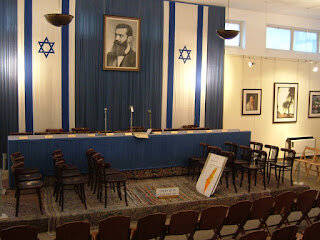
This evening marks Yom Haatzmaut--Israel Independence Day. On this day we celebrate 61 years of an independent Jewish nation in the land of Israel. In the above pictured hall David ben Gurion declared on the 5th of Iyyar 5708, "This recognition by the United Nations of the right of the Jewish people to establish their independent state may not be revoked. It is, moreover, the self-evident right of the Jewish people to be a nation, like all other nations, in its own sovereign state.... Our call goes out to the Jewish people all over the world to rally to our side in the task of immigration and development and to stand by us in the great struggle for the fulfillment of the dream of generations--the redemption of Israel." To read the full text of the Proclamation of the State of Israel click here. To listen to its concluding words in Ben Gurion's own voice, and my favorite part, the thunderous applause, click here. The applause of course captures my mood and should most reflect your feelings. Despite the fact that Israel still faces many enemies who refuse to even affirm its existence, despite the fact that the United Nations which helped to give birth to this nation has become instead more a forum for antisemitism and anti-Israel sentiment, the Jewish state continues to thrive. There people celebrate life. There people celebrate Jewish life. For thousands of years Jews only dreamed of a state in the land of Israel. Let us never take Israel for granted. Israel deserves our thanks and our applause. Take a moment to relish the fact that our generation of Jews is living the dream. "When the Lord restores the fortunes of Zion/we shall be like dreamers/our mouths shall be filled with laughter,/our tongues, with songs of joy." (Psalm 126) Amen! Applause!
Read More
Rabbi Steven Moskowitz Rabbi Steven Moskowitz

Yom HaZikaron

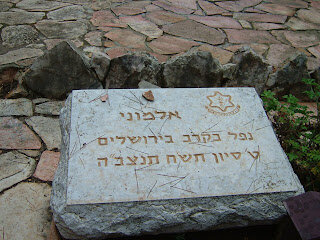
This evening begins Yom HaZikaron--Israel's Memorial Day, when we remember Israel's fallen soldiers. The gravestone above sits at Har Herzl--Israel's military cemetery in Jerusalem. It reads: "Anonymous/Fell in the Battle of Jerusalem/9 Sivan 5708 [June 16, 1948]/May his soul be bound in the bond of life." In the War of Independence Israel lost over 6,000 soldiers of a population of approximately 800,000. In all Israel mourns 22,570 soldiers. Israel paid, and continues to pay, a high price for its freedom and security. (133 died in the past year.) I remember the first time I visited Har Herzl. Unlike Arlington where one is overwhelmed and awed by the vastness of its grounds, Har Herzl makes you gasp because it appears small but is in fact deceptively large. It is terraced and built into Jerusalem's hills. There are a hundred graves here and another there and then even more around another corner. With each terrace one confronts another of Israel's wars: the dead from 1967 and those from 1973, from Lebanon and the Sinai. You think that you have completed your tour of the grounds only to discover another terrace with more dead. And then one day I stumbled upon an empty terrace, as if waiting to welcome more young sons and daughters. The empty spaces of New Montefoire make sense. One day, after many, many years, every one finds his/her way there. The empty terraces of Har Herzl do not make sense. They should not make sense. They must not make sense. Let no more terraces be cut in Jerusalem's hills. Let no more young children die to defend our land... Let our small patch of land and its people know peace.
For a poignant reflection by Rabbi David Hartman about Yom HaZikaron and Yom Haatzmaut (Independence Day) read this.
Read More
Rabbi Steven Moskowitz Rabbi Steven Moskowitz

Risk and Uncertainty

In the most recent edition of The New Yorker (April 20, 2009) James Surowiecki ("The Financial Page: Hanging Tough") offers some interesting insights about the economy and the history of how companies move ahead through recessions. Great companies are those that use such times to leap forward rather than just weathering the storm. Kellogg for example outpaced its rival Post in the late 20's, increasing its profits by 30% by 1933. Apple launched the iPod in 2001. You know the rest of that story. In the past I never read stories about the economy but these days I am drawn to them more and more. And so with this reading I learned that the economist Frank Knight makes an important distinction between risk and uncertainty. "Risk describes a situation where you have a sense of the range and likelihood of possible outcomes. Uncertainty describes a situation where it's not even clear what might happen, let alone how likely the possible outcomes are." At present most everyone's hearts are filled with uncertainty. I share that sentiment when it comes to my investments. I am worried too about paying for college. The problem is that people conflate the uncertainty of their investments with life in general. Life has always been filled with risk. The beauty of spending years absorbed in the study of ancient texts is that you come to realize that human history (and especially Jewish history) is filled with periods like today's, when people are gripped by uncertainty. This perspective of the history of thousands of years gives me strength. It gives me faith to see our current times as those certainly beset by risk, but also by unforeseen opportunities. One day, when the history of our days are written, I am certain we will be able to look back and say, "Because of 2009 we are now blessed with..." I do hope however that it is more than the snap, crackle, pop of Rice Krispies.
Read More
Rabbi Steven Moskowitz Rabbi Steven Moskowitz

Koufax Redux

It is not Sandy Koufax but I will take it. The Jets' home game against the Tennessee Titans on Sunday, September 27 has been rescheduled to a 1 pm start all because of Yom Kippur. Sunday evening is Kol Nidre. Woody Johnson, the Jets owner said, “By changing the time of the Tennessee game from 4:15 p.m. to 1 p.m., the NFL has provided the best compromise to resolve our scheduling conflict. I want to thank Commissioner Goodell and Howard Katz for quickly responding to our request to accommodate our fans of Jewish faith." Only in New York! Well this could make me a Jets fan. Of course I am pretty sure that I will still be unable to make the game...
Then there is Jimmy Kimmel's take on the issue.
Read More
Rabbi Steven Moskowitz Rabbi Steven Moskowitz

Antisemitism Again

It is remarkable that on the very evening that the Jewish world is marking Yom HaShoah (Holocaust Remembrance Day), Iran's president speaks to the UN conference against racism and offers evidence that antisemitism is not yet the stuff of history books. We did not defeat antisemitism when the Nazis were defeated. There in Durban Ahmadinejad accused Israel of being a racist and oppressive regime. Yet it is his country that openly calls for the destruction of another. It is his country that marches ever closer to building nuclear weapons. (I do not believe that a militaristic theocracy led in part by a man bent on heralding a messianic cataclysm has the noble intention of nuclear energy rather than weapons.) It is this man who calls for the annihilation of the Jews of Israel. But rather than become depressed by his hate-filled words and disenchanted by the renewed evidence of the world's oldest hatred or become enraged at the UN's inability to quell antisemitism--at least at its conferences and its failure to protect all of its member states equally, I am going to focus on a positive note. The world appears to have changed--slightly. The European diplomats in attendance walked out when Iran's president began his tirade. And there is also this. In a small Palestinian village a new Holocaust museum opened. Yad VaShem helped to translate the exhibit into Arabic. The village's elder said: "If leaders on both sides know and remember what Hitler did, maybe we will have peace." I am still waiting for much of the Arab--and Persian--world to stop denying the Holocaust and learn from recent history. But perhaps this is a start. Perhaps such a museum and such public displays of disagreement will turn history.
Read More
Rabbi Steven Moskowitz Rabbi Steven Moskowitz

Yom HaShoah


Of all the memorials at Yad VaShem I am always drawn to the "Valley of Communities." This 2.5 acre memorial is part maze and part map of Europe. It was dug out of Jerusalem's bedrock. There is a section for each country of Europe and a corner for each area of that country. All that is etched on the wall is the name of the area's largest city and then all of the surrounding Jewish towns and villages destroyed in the Shoah. In all there are over 5,000 names etched on these walls. In most cases nothing remains of these communites. For hundreds of years, prior to the Holocaust, these towns and villages teemed with Jewish life. Vilna, in particular, was the capital of Jewish learning for hundreds of years and was called in Yiddish the "Jerusalem of Lithuania." We lost not only millions of lives and millions of their descendants. We also lost centers of Jewish learning and creativity. Every year I am pursued by this question: how do you come to understand the destruction of six million lives, six million families tormented? How to undertand 5,000 communites that are no more? We can only tell the stories of individuals. This year in remembrance of the Shoah watch and listen to a survivor's story from the Yad VaShem museum. Spend a few minutes watching the testimonies of this year's torchlighters. This year discover a glimmer of what was lost.
Read More
Rabbi Steven Moskowitz Rabbi Steven Moskowitz

Passover Spices

On this Passover let us take a moment to revel in family and friends. Much has changed since we last celebrated Pesah. Much of our world has been turned upside down. Take comfort in the following. For thousands of years Jews have celebrated Passover. At times we marked this day during years of great hardship. In others during years of success and wealth. Despite the world around us, despite the history of our own day, we have continued to celebrate our holidays and gather around our tables reciting the prayers of our tradition. For generations young children have recited the four questions. For thousands of years we have eaten matzah to mark our redemption from Egypt and the day that began our history as a people. When the world is seemingly off balance and our lives appear to be following an unforeseen trajectory our traditions help return us to a straight path. Our customs help to restore balance. They remind us of what is most important. When you feel as if you are falling hold on to the haggadah. Hold on to the songs of our tradition. Look around your Seder tables and listen to our tradition's songs and prayers, open your ears to the music of dishes clanking and family members squabbling. Even this should be music to your ears. Then you can take comfort in the fact that some things are just like last year. One final note, there are many creative ways to spice up your Passover seders. For starters try adding variety to your haroset recipes. Haroset only has to look like bricks. Its taste is in your hands.
Read More
Rabbi Steven Moskowitz Rabbi Steven Moskowitz

Final Four

Ari and I just returned from our trip to the Final Four in Detroit. What an experience! Even though I was pulling for the home town favorite of Michigan State it was still a great weekend and great fun. The game on Saturday night when State beat UConn was incredible. On that night the stadium roared with the excitement of 72,000 plus fans. In the end the Tar Heels were too good for any team to handle. And so I had to let go of my loyalty to Duke and offer congrats to North Carolina and its fans. Most of all congrats to Michigan State for bringing joy and excitement to Detroit!
Read More
Rabbi Steven Moskowitz Rabbi Steven Moskowitz

Israel's New Government

As you may have read a new governing coalition has been created consisting of: Likud, Labor, Shas, Yisrael Beiteinu (Israel Our Home) and HaBayit HaYehudi (Jewish Home). It appears that Netanyahu was unable to bring in United Torah Judaism because they were too steadfast in their demands to change the Law of Return (the question of who is a Jew). He had to bring in Jewish Home as a hedge against a Labor splinter group having the power to bring down the government. Barak’s decision to join the government was a controversial decision within Labor and could very well cause a split within the party, depending on the direction of the Netanyahu government. Here is an article from Yediot Ahronot about the new government which was sworn in on Tuesday. The joke in Israel is that Netanyahu had to give away so many cabinet positions that the ceremonial picture of the new government will have to be taken in Jerusalem's Teddy stadium. Let us hope and pray that Israel's new government will lead the country with courage and resoluteness. Chazak chazak v'nitchazek! And more on a recent post (Israel's Army, March 22)... If you want to read an important article regarding the controversy about Israeli soldiers' actions in Gaza read Leon Wieseltier's recent piece in TNR. Take note of these words: "In its sad way, the recent controversy about Israel's conduct in Gaza was a beautiful thing, because the truest test of the moral condition of a society is its willingness to examine its moral condition." To this I offer a heart wrenching "Amen."

Read More
Rabbi Steven Moskowitz Rabbi Steven Moskowitz

Crosses at the Wall

There is yet another controversy brewing in the city and country seemingly filled with controversies. The pope is planning a visit to the State of Israel. The rabbi (Shmuel Rabinovitch) in charge of the Western Wall has ruled that Pope Benedict should not wear his cross when visiting this Jewish holy site. This is absurd. How is it that the pope's beliefs impinge on my beliefs or his practices on the sanctity of my holy place? Let the pope come to our Western Wall and offer a prayer. Let him pray to God as he as always done. Let him wear what he always wears. It does not lessen my faith. We will be doing more to honor the history of hatred and enmity between us by allowing him to be an authentic representative of his Christian faith than by asking him to hide his cross. I remember the previous Pope Paul's words at the Wall, said some nine years ago this month: "God of our fathers, you chose Abraham and his descendants to bring Your name to the nations: we are deeply saddened by the behavior of those who in the course of history have caused these children of Yours to suffer and asking Your forgiveness we wish to commit ourselves to genuine brotherhood with the people of the Covenant." I also remember Rabbi Melchior's words said to the visiting pope at that time: "For today we commit ourselves to end the manipulation of the sanctity of Jerusalem for political gain. Jerusalem must reject hatred, struggle, and bloodshed, and be again the 'City of Peace' and a source of holiness." Those were of course different days but I still say, even after 9-11 and the Second Intifada, Amen!
Read More
Rabbi Steven Moskowitz Rabbi Steven Moskowitz

Headwinds and Tailwinds

I have been thinking about the economy and our current crisis. I have this sense that we will be writing history in 2009. Everything is going to be rewritten. How businesses are run and how their employees (and executives) are paid. How charities are supported. How synagogues function. Much has been said about the making of history. And now we are really in the thick of it. History is hanging over our heads. For this reason I am pulled to the first century. I know that how I practice my Judaism was written during those years. I understand that the rabbis then made historic choices. They chose the Torah over the Temple--after the catastrophe of 70 C.E. when the Temple was destroyed. They chose relevance over irrelevance. The rabbis seized history over the Sadducees and Zealots. I know I am simplifying their struggles but how many Sadducees are still quoted in Jewish circles? I can only imagine the fear that gripped our people during those days. I can only imagine how afraid they were of the future. Such is the mood today. But I will not be taken in by depression. I am already planning tomorrow. I take strength from my reading of history. I believe success is determined by turning and changing. Struggling to rebuild the past is impossible, pining after what we once had a distraction. Remember the past. Turn to the future. You may be surprised to know that I not only gain strength from our history and tradition, but also from of all places, my passion for bicycling. This is why. The wonderful thing about heading out on your bike into a headwind is that you know you are going to be coming home with a tailwind. The lesson in this is simple. Every headwind can be turned into a tailwind. You just have to figure out which way to turn. People think the secret is pedaling harder but the real secret to success is turning. Don't be afraid to turn. There are many blessings to be written in your turning.
Read More
Rabbi Steven Moskowitz Rabbi Steven Moskowitz

Israel's Army

This morning's New York Times has an excellent, albeit unflattering, article about Israel and its army. My teacher Moshe Halbertal, with whom I study every summer at the Shalom Hartman Institute, is quoted at length. Moshe helped to rewrite the IDF's code of ethics and helps to teach in the Institute's officer training course. The goal of his teaching, as I see it, is to place modern, humanistic values within the language of Jewish tradition and texts. That of course is simplifying the enterprise for his project is no small job and no small matter for Israeli society. How can Israel remain a modern, democratic state, infused with Jewish language and discourse, while fighting enemies bent on its destruction? Do our enemies every forfeit their right to humanity? When does our love for the land of Israel become an intoxication that overshadows all other values and commitments? When does our love of the Bible and our enthrallment with its words overwhelm our devotion to democratic values? For me, living in the diaspora, the answers to these questions are merely theoretical. In Israel the answers are matters of life and death. There are some Israelis who take the easy way out and reject democracy--as antithetical to Judaism and others who reject Judaism--as antithetical to democracy. I am thankful to my teachers for their continuing efforts to wed the two--Judaism and democracy--in the modern State of Israel. Even though today's article might be unflattering on the surface, I remain deeply committed to the enterprise it brings to light, the painful and wrenching internal debates that are a part of the fabric of Israeli life. I pray these debates make Israel even stronger and better.
Read More
Rabbi Steven Moskowitz Rabbi Steven Moskowitz

Madoff Again

Last week Bernie Madoff finally went to jail. But his punishment will never befit his crime. I remember reading that Elie Wiesel (who lost all of his personal money as well as his foundation's dollars) suggested that the only fitting punishment would be if in Madoff's cell there was a TV screen with a perpetual interview of his victims. 24 hours a day, every day of the year, Madoff would have to watch an endless loop of interviews. He would have to watch the tears of pain, the anger, the feelings of betrayal. That would be the only show he could ever watch, the only story he could ever read. To that end Vanity Fair's video produced by Stephen Wilkes is worth watching. The sad truth is that I doubt this would have any effect on Madoff's soul. He is no different from the pocket thief (except in terms of dollars) who hugs someone while reaching into his pocket to steal his wallet. He laughed and vacationed with people who called him friend and then stole from them. Madoff gave to tzedakah with stolen funds. He was praised for his generosity and piety--when in fact his virtue was at the expense of others. Rabbi Tzvi Hirsch Koidonover, a 17th century ethical master, leveled this charge against the Madoffs of his time: Our sages have written that one does not have to guard himself against a really bad man who expresses his evil openly, but one must be on guard against the person who acts as if he were righteous, who kisses the prayer book, recites psalms and prayers day and night, yet in money matters is a “crook.” There really is no punishment that would fit Madoff's crime, although I for one think that he should be made penniless. There should be no plea bargain deals until the last of his ill gotten gains are recovered and every co-conspirator is found. That would serve justice best. Punishments I leave in God's hands. And with that I leave you with this final word from Jimmy Kimmel and Sesame Street.
Read More
Rabbi Steven Moskowitz Rabbi Steven Moskowitz

Happy Purim!


Happy Purim! For more pictures from JCB's Purim celebration follow the link in the sidebar under My Pictures. Chag Purim Samayach--may it be a Purim filled with fun, laughter and joy.
Read More
Rabbi Steven Moskowitz Rabbi Steven Moskowitz

Purim Def Poem

In honor of the upcoming holiday of Purim (beginning Monday, March 9) which celebrates, among many of its themes, Esther's growing awareness of her Jewish identity, I recommend watching the following Jewish Def Poem with Vanessa Hidary: The Hebrew Mamita. Even though this performance was recorded some years ago it is still a wonderful statement about the awakening of Jewish pride and consciousness. On Purim we remind ourselves that our people's survival is dependent on standing with Esther and declaring, as she did in the megillah, that our personal survival is intertwined with our people's.
Read More