Podcasts
Our synagogue's website has a new feature: podcasts. You can listen to my High Holiday sermons on the website or subscribe through iTunes. You will also find there regular interpretations of the weekly Torah portion, called "Three Minutes of Torah." Occasionally I will share longer talks about contemporary events.
To listen through the website click here.
To subscribe with iTunes click here.
To listen through the website click here.
To subscribe with iTunes click here.
Happy Simhat Torah!
Moadim l'simha--happy holidays! There are two Jewish ideals that are realized in the holiday of Simchat Torah which begins today, October 9 (according to the Reform and Israel calendar).
1. The joy of Torah. There is nothing more joyous than studying Torah. On Simchat Torah we celebrate the fact that we are privileged to begin again the Torah reading cycle. Simchat Torah is analogous to rebooting your computer. Even if you haven't finished all of your work, even if you haven't finished reading every story, even if you haven't finished studying every word, every once in a while you have to start all over again at the beginning.
2. You really can't dance by yourself. You need your friends. You need the swirl of others. You need your community. Celebrating by yourself is impossible. The community adds to your happiness. This is the Jewish contention. We understand this truth best when we are surrounded by others at our own simchas. This contention is truly realized when our happiness is bound to what lies at the center of our Jewish lives: Torah. Hence Simchas Torah.
On Simchat Torah, community and Torah are combined into one great song and dance.
For my YouTube video about Simchat Torah and for evidence of this truth click here. This evening's Simchat Torah/Shabbat celebration will be accompanied by a Klezmer ensemble and concert with Michael Winograd.
If you are looking to learn more about Klezmer read this article on MyJewishLearning.com.
1. The joy of Torah. There is nothing more joyous than studying Torah. On Simchat Torah we celebrate the fact that we are privileged to begin again the Torah reading cycle. Simchat Torah is analogous to rebooting your computer. Even if you haven't finished all of your work, even if you haven't finished reading every story, even if you haven't finished studying every word, every once in a while you have to start all over again at the beginning.
2. You really can't dance by yourself. You need your friends. You need the swirl of others. You need your community. Celebrating by yourself is impossible. The community adds to your happiness. This is the Jewish contention. We understand this truth best when we are surrounded by others at our own simchas. This contention is truly realized when our happiness is bound to what lies at the center of our Jewish lives: Torah. Hence Simchas Torah.
On Simchat Torah, community and Torah are combined into one great song and dance.
For my YouTube video about Simchat Torah and for evidence of this truth click here. This evening's Simchat Torah/Shabbat celebration will be accompanied by a Klezmer ensemble and concert with Michael Winograd.
If you are looking to learn more about Klezmer read this article on MyJewishLearning.com.
MEMRI Report
Although I know only a few words in Arabic (yes, hello, goodbye, let's go and peace) it is important that we make ourselves aware of what is said in the Arab media. It does not serve the cause of peace to base decisions and opinions on what is only said to the Western press. (The same would be true about Hebrew, but there does not appear as wide a gap between what Israelis say and write in Hebrew and what they say and write in English.) To that end it is worthwhile, if not depressing, to read the reports of The Middle East Media Research Institute (MEMRI). I quote here from their recent report about the Fatah conference. (Fatah is the ruling party of Mahmoud Abbas' Palestinian Authority.): "Statements made on the eve of the Fatah conference, and during its opening session, indicate that the dominant position among Fatah members is that resistance (muqawama) of various forms is a legitimate right of the Palestinian people. Most Fatah members advocated a combination of the political path with various forms of resistance - from non-violent measures such as demonstrating and planting trees to armed resistance. Except for one lone voice, none expressed a willingness to completely rule out armed resistance. Even Palestinian Authority President Mahmoud Abbas took an ambiguous stand, in contrast to past statements in which he explicitly opposed violence. It is clear that his position supports both the political process and popular resistance, but what is not clear is whether he is willing to remove the option of violent resistance from the table altogether." The rest of the report can be found here. We can only make peace if we confront what is said and written everywhere.
Addendum
Here are two more articles from this weekend's papers about the peace process, the question of settlements and the increasing tension between the Obama and Netanyahu administrations.
1. Elliott Abrams in Saturday's The Wall Street Journal: Why Israel is Nervous.
2. Tom Friedman in Sunday's The New York Times: Free Marriage Counseling.
I am sure there will be more to read in the weeks and months ahead.
1. Elliott Abrams in Saturday's The Wall Street Journal: Why Israel is Nervous.
2. Tom Friedman in Sunday's The New York Times: Free Marriage Counseling.
I am sure there will be more to read in the weeks and months ahead.
Settlements Again
We have returned to the place we were before. If only Israel would stop its settlement activity then the Palestinians would press for peace with Israel. Ok, perhaps I am overstating the case, but such seems the mood of this week's papers. So let's take a moment and clarify a few points. To my mind there are three distinct categories of what the world calls "settlements." 1. There are a large number of Israelis who live within the boundaries of the Jerusalem municipality but who live in areas that were captured from Jordan in the 1967 Six Day War. These neighborhoods of Pisgat Zeev (with 50,000 people), French Hill and others are regarded by the overwhelming majority of Israelis (and Jews) as part of the unified city of Jerusalem. Their populations range the gamut of Israeli political opinion. 2. There is another significant number who live in what may be called suburbs. These settlement blocs of Maale Adumim, Gush Etzion and Ariel each comprise some 20,000 people. It would be impossible to uproot these communities. Perhaps Israel should not have populated these areas, but had the Arab, Muslim and Palestinian world sued for peace decades ago they would have written their own, different facts on the ground. Rent the movie Unsettled to see the pain of uprooting the comparatively small number of 7,000 settlers from Gaza to understand why uprooting these areas would be overly traumatic for Israel. 3. These comprise the minority of people but the majority of air time. These settlements, some illegal and others sanctioned, are geographically isolated. They are for the most part ideologically isolated as well, at least from the majority of Israelis. The longer they are allowed to remain a part of the Israeli discourse the more such views as "Democracy is antithetical to Judaism" and "God gave the land only to the Jews" will come to dominate Israeli politics. Still I fail to understand (at least philosophically) why Jews can't choose to live in a Palestinian state just as Arabs now live in a Jewish state. This brings me to President Obama who seems to see the primary justification for the modern State of Israel as recompense for past suffering. Obama's biography is in part about transcending differences and thereby transforming suffering. But this is not all that Zionism and the State of Israel is about. The state was not founded in Uganda or Argentina (as Herzl once suggested). It does matter where it is. The West Bank and Jerusalem are the very cradle of Jewish civilization. Palestinian suffering must be ameliorated. A Palestinian State, as Benjamin Netanyahu affirmed, must be created. But it is not just a matter of you live there and I will live here. Nonetheless I still believe that the vast majority of Israelis would sacrifice these very places and even the first Jewish city of Hebron if the Palestinians and Arabs would affirm the right of the Jewish state to exist in the land of Israel (and that means religious, historical, philosophical and international right). I will continue to pray for peace but I remain skeptical if the current round of chastisements are only directed at those who are the most sensitive to rebuke. Read these articles for more insights on the current debate: Yossi Klein HaLevi's in The New Republic, Aluf Benn's in The New York Times and of course Donniel Hartman's article on the Jewish necessity of a two-state solution, found on the Shalom Hartman Institute website.
Tisha B'Av
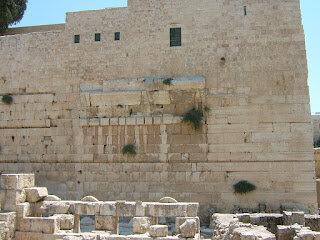
Pictured above is Robinson's Arch just south of the Western Wall. When standing here one is taken by what must have been the enormity of the Temple Mount. Today we commemorate Tisha B'Av (9th of Av), the day on which the Romans destroyed the Second Temple in 70 CE (as well as a number of other Jewish tragedies). I know I am supposed to be mourning. I know I am supposed to be fasting. I know I am supposed to be praying for the Temple to be rebuilt, Jewish sovereignty restored, the exiles to return to their land... But given that nearly six million Jews have returned to the land of Israel and given that Jewish sovereignty is reborn in the modern State of Israel, I no longer mourn. I refuse to allow the burdens of history to weigh me down. There is an inherent tension when learning history. One is pulled between taking to heart the lessons of history and refusing to let history go. I for one have internalized the Zionist message. The past will not determine our future. The past will not enslave the present. I must be guided by it, but I cannot be ruled it. And so I always remember the tragedies of the past (as a Jew they are forever entangled in my kishkes) but more importantly I celebrate the present. When it comes to the choice between a present filled with hope and a past steeped in sorrow, I choose hope.
Kosher Apple Jacks?
I did not know Apple Jacks were kosher. I never really bothered to ask or to think about it. I won't eat them for a variety of reasons. But when you do think about it you have to ask, how can a cereal that is mostly sugar and that is not healthy for kids really be kosher? Oh, you might say that I am missing the point. The point is that for those for whom this matters the cereal has a hekhsher and they can eat them or not depending on their penchant for sweet cereal. But then this weekend I discovered how even the most kosher of cereals can become trafe. We read the tale of rabbis accused of laundering money and in some instances even hiding cash in Apple Jacks cereal boxes (and apparently selling human organs on the black market as well!). If you really want to read more about this sad and embarrassing story click here. And so the real point is that kosher is not just about the food we place in our mouths. The kosher certification on the outside of the box cannot make unethical behavior ethical, cannot transform trafe into kosher. There are some who are by all appearances religious, but in actuality are anything but. When someone is scrupulous in their ritual observance but ignores such basic human, ethical mitzvot, such as "You shall not steal," they are not religious. The fact that they are rabbis and are therefore regarded as representatives of religion in general and Judaism in particular is in the Talmud's estimation, a hillul ha-Shem--a desecration of God's name. I am saddened and embarrassed that the Torah I so love was defamed, that people will now say, "Why do I need religion?" My answer might be: You need religion to remind you that no matter what cereal you eat in the morning, you require a community, a book and a God to prod you to do good in this world. No one sees what you eat for breakfast, everyone sees (eventually) whether your hands bring healing or harm.
The People of Jerusalem
Enjoy my latest video of the people of Jerusalem. You can find it on my YouTube channel. There is a wonderful mix of people here. It is certainly no melting pot and sometimes there are even clashes. During my stay here there were protests about a parking garage being open on Shabbat and violent protests when social services intervened in order to hospitalize a toddler from the Neturei Karta Hasidic sect. For a summary of this particularly troubling incident and the issues involved read this Jerusalem Post article. Despite this simmering tension between Jerusalem's Zionist and non-Zionist Jewish populations, on most days all co-exist. Jerusalem is a wonderful city, filled with life. Enjoy the videos.
The Object of Art
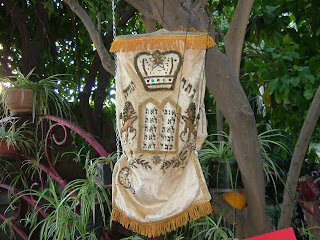 Last week we visited Israeli artist, Jo Milgrom. She is the mother of my colleague and friend, Rabbi Shira Milgrom. Her sculpture garden features "recycled" Jewish ceremonial objects. She collects discarded tefillin, Torah covers and other assorted objects and turns them into artwork. She said, "'Turn it over' may also mean 'overturn it,' to escape sameness and stereotype. Better a fiesty, controversial life than dullness and burial." For a number of my colleagues her artwork turned sacred into profane. I, on the other hand, found that it to gave new life to ancient symbols. Sometimes you have to be forced to look at things in new, surprising, different, controversial and perhaps what might even be called sacrilegious ways to appreciate their deeper meaning. Is it unholy to place a Torah mantle in a different context and to hang it from a living tree rather than covering what Jewish tradition terms the "tree of life"--the Torah? This could not be the sculpture garden of a synagogue but it makes you think. Thinking in new categories is one of the objects of art. For more pictures of her artwork click here.
Mount of Olives
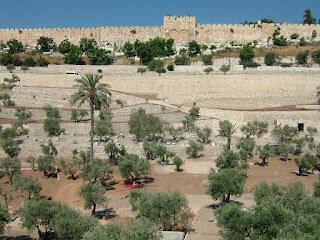 Today our group traveled to the Mount of Olives and in particular to the churches and cemeteries on the east side of the Old City. On top of the mount is what may be called the holiest Jewish cemetery. Here such Jewish greats as Ramban (Nachmanides), Menachem Begin (prime minister), Shai Agnon (Israeli Nobel laureate) and Rabbi Abraham Isaac Kook (first chief rabbi and mystic) are buried. Here Jesus spent the evening with his disciples before his crucifixion. Although it is in the heart of East Jerusalem it provides an extraordinary view of the Old City, the slope of the mountain gives the impression that one is peering into the confines of the city's walls. From this vantage point the golden dome of the Dome of the Rock, the silver cupola of the Church of the Holy Sepulchre and the new, white gleaming dome of the Hurva (Ramban) synagogue now being rebuilt can be seen. For more pictures click here. As one walks down the hill one moves from a Jewish cemetery, to Christian graves and churches to Moslem graves. Each successive ruler built their cemetery closer to the walls, although Zechariah's enormous grave is located in the valley. The gates to the Old City in the picture above were covered by Muslim conquerors because it was through these gates that the Jewish messiah would enter after resurrecting the dead on the Mount of Olives. (I never really understood why a messiah would be turned back by bricks, but such has always been the politics of this place.) It is for this reason that this mount continues to hold special power over Jews. Here they will first experience the redemption and therefore be the first to be resurrected. I have never felt the pull of such graves. History has its pull, but not graves as holy places. It is instead the living, bustling city, that continues to serve as the holiest of destinations.
Idan Raichel Concert
This evening my friends and I went to the Idan Raichel concert at the Israel Museum's sculpture garden. It was a perfect Jerusalem evening, with a comfortable breeze and a few stars scattered across the sky. In attendance were a mixture of young and old, secular and religious. Idan Raichel is a most unlikely image. He is of Ashkenazi roots but looks more like a Rastafarian. His songs are sung in Hebrew, Amharic (Ethopian) Arabic, Ladino and even English. He plays the electric keyboard and accordion. There is a mixture of instruments: electric guitars, oud (Arab guitar), flute, clarinet, shofar, and an array of percussion (my favorite being what appeared to be an upside down wooden salad bowl in a pale of water). It is a mixture of Middle Eastern, Latin and Ethiopian music. He appears to be like my favorite Johnny Clegg, who as a Jewish youth in South Africa combined the sounds of Zulu with English lyrics--years before Paul Simon's Graceland. I have no doubt we will hear more about Idan Raichel. Go to his website for more information about his work and watch this trailer to get a feel about his band's extraordinary trip to Ethiopia. This evening's concert began with the words: erev tov Yerushalayim--gooood evening Jerusalem! To my ears I still hear prayer when I hear Yerushalayim, but this evening's concert was instead the living reality of Israeli life. It is not a prayer. It is a mixture of cultures and languages, black and white, Ashkenazi and Sephardi, Hebrew and Arabic, English and Amharic.
Jerusalem Shabbat
It was a wonderful Shabbat in Jerusalem. For Kabbalat Shabbat services I attended Shira Hadasha, a modern Orthodox synagogue, filled with hundreds of young people. Like most Orthodox synagogues there is a mehitza, a curtain partition separating the men's and women's sections. Unlike most, both men and women lead the praying. Not a word of the prayerbook is skipped. All the words are sung to wonderful melodies. For Shabbat morning services I attended a Reform synagogue, Mevakshei Derekh, where my cousin is the cantor. They use an Israeli Orthodox prayerbook, but make a number of changes in the prayers. Since everyone is comfortable with the Hebrew, the changes are made by the congregants and not in the printed prayerbook. There was a bat mitzvah, with her especially proud parents, and an informal kiddush. It looked and felt most like our services except of course that it was all in Hebrew--even of course the announcements. At both of these synagogues I felt welcome, although given that their customs are unlike ours I did not feel entirely at home. I felt the least at home on Shabbat afternoon when my friends and I walked to the Old City. There we find a Sephardic minyan praying minhah (the afternoon service). Their beautiful Torah scroll housed in a silver case was magnificent. We were welcomed, but the service, although familiar, was not at all my own. I stood with my friends for whom this traditional service had far more pull. Then I realized that in every other place one must think about which direction we face for our prayers. When we are standing at a shiva home on Long Island we discuss which way is East. When I am standing in Jerusalem the question is: which direction is the Wall. When standing at the Wall, the stones beckon you to prayer. After a long Shabbat walk from the Old City to the Tayelet I returned to Emek Refaim for Motzei Shabbat--the going out of Shabbat. The empty streets began to return to life. The restaurants and cafes began to fill with people by 9 pm. The streets were still crowded at 12 midnight. Here in Jerusalem Shabbat mirrors the seasons. In the heat of Shabbat afternoon the city rests and it was very few people to be found strolling. In the evening, following havdalah, the city returns to play. Walking these streets is where I feel most at home, and where my prayers feel answered.
Blessing of Rain
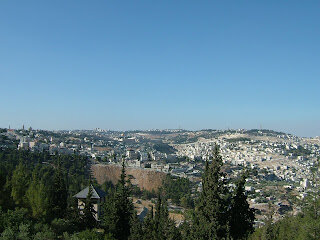 One of my favorite spots in Jerusalem is the Tayelet, a promenade facing the south side of the Old City. Above is a picture taken from this spot. Click here to view more pictures taken from the Tayelet. The other day there was the most surprising of occurrences, a brief misting of rain. It was not a rain like we are accustomed to in New York. Nonetheless it was the rarest of events. It seemed to herald a new mood here. I sense a greater feeling of optimism and hope this summer. In the Amidah we add the prayer for rain during Israel's winter rainy season. When here we add the words: morid ha-tal--who causes the dew to fall--in the summer. Until the other day this was purely theoretical and only an imagined reality. Walking the streets of Jerusalem I felt the mist of these words for the first time. I smiled as I felt Jerusalem's bright sun and this brief rain. It was a day where my prayers met my reality. The possibilities for such a realization are more likely to occur here in the land of Israel rather than in my New York home. This place makes for unforeseen opportunities for hopes, dreams and prayers to be realized. Amen.
Shabbat Shalom from Jerusalem
Everything feels different here--in Jerusalem. When I am in the States I worry about the threat of Iran. I worry about the unlikelihood of peace with the Palestinians--and disagreements with the new Obama administration. I worry about the simmering tensions with the ultra-Orthodox. (In fact there were riots yesterday in the city's ultra-Orthodox neighborhoods.) Still when I am here it feels entirely different. I arrived to find the mood upbeat and hopeful. There are less guards and soldiers. The outdoor pedestrian mall of Ben Yehuda is packed with people. The cafes of Emek Refaim are filled. This is the most optimistic I have found Israel in the past seven years. Still just being here fills me with hope. The lover when separated from his beloved, by the expanse of oceans, worries about his beloved far too much. The heart cannot be placated from afar. But when he is with her his heart is at ease. As the Psalmist proclaimed: "When the Lord restores the fortunes of Zion, we shall be like dreamers, our mouths shall be filled with laughter, our tongues with songs of joy." (Psalm 126) To view a brief video message on this theme click here.
Hiking Wadi Qelt
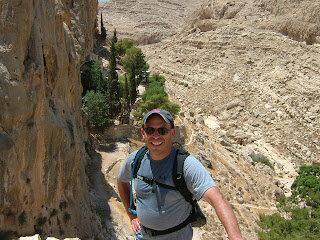 Today a number of us hiked Wadi Qelt, in Hebrew Nahal Prat. A wadi the Arabic term for a dry river bed that runs through the desert. The last time I hiked Wadi Qelt was some 20 years ago. I had been unable to return here because of the turmoil of the past years and in particular the first and second intifada. Even though Wadi Qelt is right outside of Jerusalem, it is in the West Bank and therefore few hiked there. It was in fact the site of a number of terrorist attacks in the past decades. Today this all seemed like ancient history. It is a striking place. (During my winter visits it is off limits because of the danger of flash floods.) The heat and barren hills of the Judean desert soon give way to the cool waters of the spring fed stream. There are pools to swim in and lush vegetation, particular wild mint called Nana, to be found in the wadi. Hundreds of school children played in the pools nearest the spring. Two monasteries are carved into the cliffs. The square holes that served as the monks entrances to their solitary caves can still be seen. For me there is nothing like climbing these hills and swimming in spring fed pools in a barren desert. It is in places like these that Abraham first dreamed of God--and where today I better understood his dreams. The lines of life and death, faith and drought, water and barrenness, seem much clearer in this desert. For more pictures of our trip click here.
YouTube Walking Tour
We did not have classes on Friday so I spent several hours walking around my favorite city. I walked from my apartment on Emek Refaim through the Old City and to Mahane Yehuda, the open air Jewish market. Follow the link to watch the video I made with my new camera. I am just getting the hang of making and editing videos so you will have to forgive this first, rough attempt. Nonetheless I hope this short video gives you a feel of the city I love. You can watch the video by clicking here.