Report from Jerusalem
At present I am studying at Jerusalem's Shalom Hartman Institute. We have had many classes, lectures, discussions and a few moments to enjoy Jerusalem. More about the classes and learning in another post, and perhaps some thoughts about my wanderings through this city's streets another time. For now one impression. Nothing has seemingly changed since I was last here in July. I often marvel that the news from afar about the place in which I now sit seems always more depressing when there than here. Israel appears on the edge of crisis, facing missiles and enemies within and without, yet when here little seems amiss. With the exception of the disastrous construction project, building a rail line cutting through the center of town on Jaffa Street very little seems to have changed in six months. I am not one to dismiss Israel's struggles in a cavalier manner, but when here in Jerusalem they seem less pressing than when there on Long Island. Perhaps it is only my heart that is so at ease. I feel at home in Jerusalem. I would like to believe that all would feel similarly if they were here visiting Israel as well.
Israel Helping Haiti Part 2
I am sure that you join me in praying for the people of Haiti. The destruction and continued suffering are difficult to comprehend. In the midst of this there is a bright spot for the Jewish people. Days after the earthquake, Israel rushed aid to Haiti. As of January 20th, 383 people have been treated in the IDF's field hospital, among them dozens of children, 140 life-saving operations have been performed, 60 patients are currently hospitalized and 7 babies have been born in the hospital. View the CNN video now making the rounds among those of us who feel that we can now really hold our Jewish heads high. Caring for the world at large seems to feed that part of our being more than just caring for ourselves. For more details about Israel's efforts and many more videos visit the Israeli government website. Then again today's Times reports that Israelis feel great ambivalence about the aid efforts. I for one am still hounded by the innumerable articles, sermons and discussions about God's role in the disaster. I fail to understand the tendency to blame the Haitians for this earthquake or the need to defend God before the indifference of nature. Read this week's New Yorker for more on this theme. Let's be honest about nature. Let's be honest about faith. And so I conclude with the words of the Psalmist: "God is our refuge and stronghold, a help in trouble, very near. Therefore we are not afraid though the earth reels..."
Wearing a Religious Device
If you have not read about this you have to watch the following YouTube video about how a Jewish teenager's wearing of tefillin forced a US Airways flight to make an emergency landing. I am sure that this is not what God intended when saying, "Therefore impress these My words upon your very heart: bind them as a sign on your hand and let them serve as a symbol on your forehead, and teach them to your children..." (Deuteronomy 11) The police officer's characterization of tefillin as a religious device is most unusual.
Israel Helping Haiti
I wish the American media covered stories such as these. It is a brief video of the IDF unit helping Haiti's earthquake victims. The Israeli soldiers delivered a baby who is now named, "Israel."
Responding to Haiti
I respond to the ongoing tragedy in Haiti first with prayer and then with action.
And so I begin with a prayer written by Rabbi Jonathan Sacks. It was first composed in response to the 2004 Tsunami: "We join our prayers to the prayers of others throughout the world, for the victims of the earthquake which this week has brought destruction and disaster to many lives. Almighty God, we pray You send healing to the injured, comfort to the bereaved, and news to those who sit and wait. May You be with those who even now are engaged in the work of rescue. May You send Your strength to those who are striving to heal the injured, give shelter to the homeless, and bring food and water to those in need. May You bless the work of their hands, and may they merit to save lives. Almighty God, we recognize how small we are, and how powerless in the face of nature when its full power is unleashed. Therefore, open our hearts in prayer and our hands in generosity, so that our words may bring comfort and our gifts bring aid. Be with us now and with all humanity as we strive to mend what has been injured and rebuild what has been destroyed. Ken Yehi Ratzon, ve-nomar Amen. May it be Your will, and let us say Amen."
Second, I offer this picture of the State of Israel's quick humanitarian response. The Israel Defense Forces’ emergency aid team arrived in Haiti on January 15. It consists of a medical unit as well as search and rescue teams. The mission has established a major field hospital adjacent to Port-au-Prince’s soccer stadium. At present this is one of the largest medical facilities currently operating in Haiti with the capacity to treat up to 500 patients per day. To view more pictures follow this link.

And so I begin with a prayer written by Rabbi Jonathan Sacks. It was first composed in response to the 2004 Tsunami: "We join our prayers to the prayers of others throughout the world, for the victims of the earthquake which this week has brought destruction and disaster to many lives. Almighty God, we pray You send healing to the injured, comfort to the bereaved, and news to those who sit and wait. May You be with those who even now are engaged in the work of rescue. May You send Your strength to those who are striving to heal the injured, give shelter to the homeless, and bring food and water to those in need. May You bless the work of their hands, and may they merit to save lives. Almighty God, we recognize how small we are, and how powerless in the face of nature when its full power is unleashed. Therefore, open our hearts in prayer and our hands in generosity, so that our words may bring comfort and our gifts bring aid. Be with us now and with all humanity as we strive to mend what has been injured and rebuild what has been destroyed. Ken Yehi Ratzon, ve-nomar Amen. May it be Your will, and let us say Amen."
Second, I offer this picture of the State of Israel's quick humanitarian response. The Israel Defense Forces’ emergency aid team arrived in Haiti on January 15. It consists of a medical unit as well as search and rescue teams. The mission has established a major field hospital adjacent to Port-au-Prince’s soccer stadium. At present this is one of the largest medical facilities currently operating in Haiti with the capacity to treat up to 500 patients per day. To view more pictures follow this link.
And finally I urge you to join me in giving tzedakah in order to support the ongoing efforts of the many aid organizations now working in Haiti. I am giving to the American Jewish World Service. This is always my top pick in such situations. To read more of the AJWS's efforts follow this link. May healing soon come to the nation and people of Haiti!
Follow Up
Here are two recent articles related to my post Stopping Terror.
In yesterday's Wall Street Journal, Bret Stephens writes: "One of life's paradoxes is that we are as often undone by our virtues as by our vices. And so it is with civilizations, ours not least." I disagree that torture (that is my view of waterboarding) should ever be permitted. I agree that we should stop worrying about political correctness. Terrorism is a danger coming from the Muslim world.
In today's New York Times, Tom Friedman writes: "Finding people with the courage to confront that breakdown — the one identified by the father, the one that lures young Muslims away from the mainstream into a willingness to commit suicide against innocent civilians as part of some jihadist power fantasy — is what matters most right now." Until the Muslim world loudly cries: these terrorists are our enemies as well, this is not Islam; we have no choice but to add their countries' citizens to the list requiring extra searches.
In yesterday's Wall Street Journal, Bret Stephens writes: "One of life's paradoxes is that we are as often undone by our virtues as by our vices. And so it is with civilizations, ours not least." I disagree that torture (that is my view of waterboarding) should ever be permitted. I agree that we should stop worrying about political correctness. Terrorism is a danger coming from the Muslim world.
In today's New York Times, Tom Friedman writes: "Finding people with the courage to confront that breakdown — the one identified by the father, the one that lures young Muslims away from the mainstream into a willingness to commit suicide against innocent civilians as part of some jihadist power fantasy — is what matters most right now." Until the Muslim world loudly cries: these terrorists are our enemies as well, this is not Islam; we have no choice but to add their countries' citizens to the list requiring extra searches.
Pope Pius XII
A great deal has been written in the Jewish press about the march to canonizing Pope Pius XII as a saint. In Jewish eyes the man who served as pope during the Holocaust remains a controversial figure. Did he do enough to save Jews from the Nazi onslaught? Did he do enough to save Europe from the evils of the Nazi regime? It seems clear to me that he did not. To be honest there were few in power who did enough. The United States failed to bomb the tracks leading to Auschwitz arguing that it would divert valuable resources from the war effort. We turned away the SS St Louis from our American shores, sending hundreds back to Germany and most to death. Some historians have argued that this act emboldened Hitler (y"s) in his march to the final solution. Through the lens of historical hindsight few did enough. There were of course a few extraordinary individuals. These righteous gentiles were almost always simple, pious folk and not those who occupied positions of leadership or power. Read Yad VaShem's account of the righteous gentiles here. I wish the Pope did more. I also wish the Catholic Church would open its archives so we can learn more of the history. The question about Pope Pius becoming a saint is different. I believe every human being is fallible. This is part of what makes me a Jew. This is what I learn from reading the Bible. Moses is a great leader but given to anger. David is an extraordinary warrior and poet but given to, shall we say, sexual indiscretions and even murder. I would not call these leaders saints. I would not call anyone a saint. I believe that people are given to errors. I believe in the infallibility of no one. I have no saints. I have only one God. Whether Catholics call Pope Pius a saint is in their hands. The issue is more a matter of Catholic belief than Jewish history. Jewish belief is clear on this point. History has yet to rule on the matter. For more information about Pope Pius's wartime record read this article.
Stopping Terror
I just returned from a short trip to visit my parents in St. Louis. I traveled through the airports with relative ease despite the increased security following the attempted terror attack in Detroit. My bag was searched by hand at Laguardia and my tubes of shaving cream and toothpaste were confiscated. (I always forget that four ounce rule.) Herein lies the problem with our current system. We make new regulations and restrictions in response to each thwarted (thank God!) attack. We have to take off our shoes. We can't carry on toothpaste. But our approach is backwards. We are so wrapped up in individual rights and so worried about trampling on them that we are left to regulating objects and things. Unfortunately our enemies are individuals not things. Terrorism is an instrument used by hate filled individuals. People whose hearts are so steeped in hate will find whatever things they can place their hands on to cause damage, destruction, fear and terror. So we need to worry more about the individuals who would cause us harm. We need to call such individuals our enemies. We need to identify them before they board a plane. One clear and decisive rule would be this. If a father alerts authorities about his son's increasing radical views then he should be placed on an immediate no-fly list. If your dad turns you in then you are really headed for trouble. I can't imagine doing something so terrible that my dad would call the police first. But this very bewilderment explains why I went to St. Louis in the first place. And one final point. Regulating things creates the illusion that we can fashion a system that is 100% effective. All you have to do is design a better machine to detect my potentially harmful five ounce tube of toothpaste. (See David Brook's recent column for more about this point.) This illusion keeps us from the more important task of identifying hate-filled individuals before they can cause us harm. Unfortunately you can never keep out all of our enemies. Terrorism will be a part of our landscape for a long time to come. But you can prevent it from creeping into your hearts. You can prevent it from sowing hate. That, and that alone, is 100% in our hands.
Belated Happy Hanukkah
Last week I attended my daughter's high school winter concert. She sings in the school choir. Here are the songs they performed: Siyahamba (a South African Swahili hymn), Maoz Tzur (our very own Rock of Ages), Noche de Luz (Night of Silence), I'll be There (by the Jackson 5), The Storm is Passing Over (a Gospel standard) and the Halleluyah Chorus (from Handel's Messiah). First of all let's state the obvious. A far more diverse selection of music than the days of Solomon Schechter! And also to be honest, I have still not come to terms with the conflicting feelings of seeing and hearing my daughter sing verses from the New Testament's Book of Revelation (that is what the Halleluyah chorus is structured around). My feelings are something of a mixture of "Wow, she sings so well. It makes me so proud." with "That's not what we believe. No, we are still waiting." Nonetheless the multi-ethnic quality of the occasion was wonderful to behold and despite the inability of Maoz Tzur to measure up to the music of Handel and great Gospel (I love Gospel!) I was taken in by the event's pluralism. And this of course brings me to Hanukkah. The Maccabees would have been none too pleased. This concert and the celebration of Hanukkah in the midst of a non-Jewish culture would have, to be honest to our history, angered them. David Brooks had it right in his New York Times column. The heroes of the Hanukkah story were radical in their ideology. "They were right and the rest of the world wrong" was their motto. There was nothing good to be found in the non-Jewish world. Its influences must be opposed at all costs. It is this kind of ideology that leads some to destroy, apparently, a mosque in Israel's West Bank. Read the Jerusalem Post's account here and the New York Times account of this tragic tale and its aftermath here. This destructive act appears to have been a deliberate attempt to live by the Maccabees' values. And herein lies the essence of Hanukkah in today's world. The overwhelming majority of the Jewish world celebrates Hanukkah and the victory of the Maccabees but does not call its heroes' values their own. We live in two worlds. We have one foot in the Jewish world and one in the non-Jewish world. Even at day schools where we only sing our own songs, we live in two worlds. Even in Israel, in our sovereign Jewish state, we are both Jewish and modern. In my new world we sing their songs. They sing ours. That is how I choose to live. I am thankful for the victory of centuries ago. I am thankful as well that the Maccabees did not remain in power for very long. I also hope and pray that their ideology never rules the day. There is good to be found in my world and the outside world. It is easier and simpler to be a fanatic and say "Only I am right. Only my Jewish world." I choose instead complicated and nuanced. And by the way my Shira sang beautifully!
Orrin Hatch's Hanukkah Song
I am sure you read about this in The New York Times. I am still not sure what to say about it... Happy Hanukkah from Senator Orrin Hatch!? I guess the response is better left to song: "I'm dreaming of a white Christmas..."
Eight Days of Hanukkah from Tablet Magazine on Vimeo.
And by the way, here is the story of that most famous of Christmas songs.
Eight Days of Hanukkah from Tablet Magazine on Vimeo.
And by the way, here is the story of that most famous of Christmas songs.
Helping Others
During this Hanukkah our synagogue reached out to those in our community who are hungry and homeless. We donated gift cards to the Interfaith Nutrition Network's Mary Brennan Soup Kitchen so that we can help restore a measure of dignity to those dependent on tzedakah. It means a great deal for people to go shopping for themselves and buy what they need and perhaps even what they might want. That is of course what I sometimes get to do! At the INN, I helped Rob sort donated clothes and in particular winter coats. You can watch the YouTube video of my visit here. On Wednesday our confirmation students met with Dennis and Lisa from the Interfaith Assembly on Homelessness and Housing. Both Dennis and Lisa were formerly homeless and shared powerful personal stories with our students. Lisa spoke about her struggle with bipolar disorder and being unjustly evicted from her apartment because of her mental illness. Dennis spoke about living on the streets of New York City for fourteen years. He told us about eating food out of garbage cans. He shared with the students his struggle with crack addiction. He spoke of the kindness of a few individuals. This morning I delivered 200 lunch bags filled with fruit, juice, snacks and turkey sandwiches to St. Hugh's Project Hope. Thank you to the seventh graders for their help in preparing these meals. Thank you to Joe, Robin, Susan and Renee for their added support! Danny of Project Hope will deliver these lunches to Latino day laborers in the Huntington Station area today and tomorrow. It is remarkable to think that less than two miles from my home there are people who do not have enough money to buy food for themselves. A few statistics. The INN serves 400-500 people per day--on our very own Long Island. Project Hope distributes 100 lunches per day--in my very own town. In New York City there are over 37,000 people living in shelters. The numbers are staggering. And these are only the official counts. In the end, one would be too many! So on this Hanukkah I rededicate myself to helping those less fortunate than myself. I can do more. We can do more. I say with the prophet Isaiah, who told us of our most important duty: "It is to share your bread with the hungry, and to take the wretched poor into your home; when you see the naked, to clothe him, and not to ignore your own kin." (Isaiah 58) The final line is the most important point. We cannot fix all of the world's problems. We cannot even end hunger. But we also cannot ignore the issues! We must open our hands to the needy. One at a time. One sandwich at a time. One act of hesed can bring healing to one small world. That is where we will begin. That is the only place where we can begin. Turning aside is not a Jewish option.
Tom Friedman Column
In today's New York Times, Tom Friedman writes about the narrative of hate and blame that permeates throughout the Middle East. I quote from his conclusion in which he addresses himself to Muslims. "Whenever something like Fort Hood happens you say, ‘This is not Islam.’ I believe that. But you keep telling us what Islam isn’t. You need to tell us what it is and show us how its positive interpretations are being promoted in your schools and mosques. If this is not Islam, then why is it that a million Muslims will pour into the streets to protest Danish cartoons of the Prophet Muhammad, but not one will take to the streets to protest Muslim suicide bombers who blow up other Muslims, real people, created in the image of God? You need to explain that to us — and to yourselves." There is of course plenty of blame to go around. Israel and the United States are certainly not perfect. (I love them despite their imperfections.) But the heart of the matter continues to be the issue that Friedman writes about in today's paper. I would add to his words: "Rise up. Protest. Take to the streets — not against something, but for something. Tell the world no longer what you want to destroy, but what you want to create." I would advise Muslim leaders with the principle by which I have always tried to live my life. Whenever there are problems to be addressed and repaired it cannot only be about what others are doing wrong. It must first be about what I am doing wrong. I have always believed that repair begins with oneself. Anger is only useful when it is directed inward. To read Friedman's entire column follow this link. To read a somewhat related article about President Obama's handling of foreign policy, read Leon Wieseltier's most recent piece in The New Republic. In Wieseltier's, and my, view we should have more actively supported those in the Middle East (in particular Iran) who did indeed take to the streets, attempting to create something positive. How we help to nurture a more positive narrative continues to be the question of the day.
Returning Thanks
As always Thanksgiving brings with it the blessings of family and perhaps too much food. Given our blessings I am very proud that our synagogue is organizing a number of projects to help those who are less fortunate than ourselves. On December 9, JCB volunteers will help to sort the many toys and food donated to the Interfaith Nutrition Network's Mary Brennan Soup Kitchen in Hempstead. In addition JCB members will donate gift cards so that INN patrons can purchase what they need themselves and thereby redeem a measure of their dignity. At our next confirmation class, on December 16, a former homeless person, now working for the Interfaith Assembly on Homelessness and Housing, will share his story and educate our students and their parents about the problems of hunger and homelessness. This is a rare opportunity to hear a personal story. Far too often we separate ourselves from these difficulties in our suburban bubbles. We think this is not a problem in our neighborhood. This is not our problem. But as Jews we must never distance ourselves from others and their difficulties. We know the feeling of the stranger. Finally, on December 17, our 7th graders and fellow congregants will pack lunch bags and sandwiches to be delivered to the hungry and poor in the Huntington Station area. These items will be delivered through the Saint Hugh's Project Hope. We can never repair all of the world's problems. We can also never say that there are too many problems to fix. We must start somewhere. We must try to repair our world. Let us begin by trying to address the problem of hunger in our very own neighborhood!
The Third Intifada | The New Republic
The Third Intifada | The New Republic
Here is a rather depressing article from TNR about the simmering tensions among Palestinians and the worries about a potential third intifada. The sad and tragic fact is that Palestinian leaders continue to believe that the only way to advance their legitimate aspirations for statehood is through violence. You cannot build a nation on hatred and violence. Until Palestinians accommodate their thinking and affirm the legitimacy of the Jewish state in the land of Israel we will only see times of sheket--relative quiet and never shalom--peace. Israel can withdraw from this territory or that. Israel can halt the expansion of "settlements" or not. The fundamental issue is that the majority of Israelis have accepted Palestinian aspirations as legitimate whereas the majority of Palestinians (at least as expressed by their leaders) have yet to come to terms not only with Jewish aspirations but Jewish history and present reality. I continue to believe that if Palestinian leaders would truly affirm these and say in English, Hebrew and especially Arabic, "The State of Israel is here to stay. Its establishment was recognized by the United Nations over sixty years ago. It is built on the Jewish people's historical connection to this land that we also hold dear..." the rest of the details could be worked out at the negotiating table.
Addendum: On a more positive note read this TNR post discussing secret talks between Israel and the Palestinians.
Here is a rather depressing article from TNR about the simmering tensions among Palestinians and the worries about a potential third intifada. The sad and tragic fact is that Palestinian leaders continue to believe that the only way to advance their legitimate aspirations for statehood is through violence. You cannot build a nation on hatred and violence. Until Palestinians accommodate their thinking and affirm the legitimacy of the Jewish state in the land of Israel we will only see times of sheket--relative quiet and never shalom--peace. Israel can withdraw from this territory or that. Israel can halt the expansion of "settlements" or not. The fundamental issue is that the majority of Israelis have accepted Palestinian aspirations as legitimate whereas the majority of Palestinians (at least as expressed by their leaders) have yet to come to terms not only with Jewish aspirations but Jewish history and present reality. I continue to believe that if Palestinian leaders would truly affirm these and say in English, Hebrew and especially Arabic, "The State of Israel is here to stay. Its establishment was recognized by the United Nations over sixty years ago. It is built on the Jewish people's historical connection to this land that we also hold dear..." the rest of the details could be worked out at the negotiating table.
Addendum: On a more positive note read this TNR post discussing secret talks between Israel and the Palestinians.
A Serious Man
I just saw the Coen brothers' new film. "A Serious Man." It is a must see. It is as the reviewers have noted a modern midrash on the biblical Job. It is the story of a math professor who believes that life in general and his life in particular should follow certain understandable and definable formulas. Of course life does not. As his life unravels he, unlike his brother and like Job, never curses God and tries to uncover life's hidden meaning and seeks out the advice of three rabbis. The rabbis all fail, some worse than others. The below clip contains my favorite scene. "The rabbi is busy... He is thinking." The most senior rabbi actually refuses to meet with the serious man. The other rabbis either give entirely inadequate answers or tell a story rather than answer the question. The best answer is of course "He is thinking." That is the only answer we have.
Some have suggested that the movie is self hating and portrays an unflattering picture of American Judaism, Jews and rabbis. I disagree. It is honest, perhaps brutally so. I feel the inadequacy of sitting at the other side of the table from the serious man. How can anyone really understand and answer life's mysteries? That is the essence of the Job story. Many (especially rabbis) pretend to have it all figured out. That is what the movie and the biblical Job rejects. There is more to write about and discuss: the portrayal of the relation between Jews and "goyim," the picture of Hebrew School and bar mitzvahs and of course the prominence of Jefferson Airplane. The movie is framed by two quotes. It begins with a quote from Rashi, the great medieval Jewish commentator: "React with simplicity to everything that happens to you." and concludes with Jefferson Airplane: "When the truth is found to be lies, and all the joy within you dies." Somewhere, sandwiched in between tradition and modernity, and while tossed around by the whirlwind (here a tornado), we uncover our inadequate answers to life's mysteries. Rabbis can't figure it all out for you! If you would like to participate in a discussion about the film, go to our synagogue's Facebook fan page.
Some have suggested that the movie is self hating and portrays an unflattering picture of American Judaism, Jews and rabbis. I disagree. It is honest, perhaps brutally so. I feel the inadequacy of sitting at the other side of the table from the serious man. How can anyone really understand and answer life's mysteries? That is the essence of the Job story. Many (especially rabbis) pretend to have it all figured out. That is what the movie and the biblical Job rejects. There is more to write about and discuss: the portrayal of the relation between Jews and "goyim," the picture of Hebrew School and bar mitzvahs and of course the prominence of Jefferson Airplane. The movie is framed by two quotes. It begins with a quote from Rashi, the great medieval Jewish commentator: "React with simplicity to everything that happens to you." and concludes with Jefferson Airplane: "When the truth is found to be lies, and all the joy within you dies." Somewhere, sandwiched in between tradition and modernity, and while tossed around by the whirlwind (here a tornado), we uncover our inadequate answers to life's mysteries. Rabbis can't figure it all out for you! If you would like to participate in a discussion about the film, go to our synagogue's Facebook fan page.
Springsteen Concert
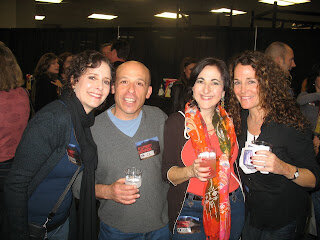 After yesterday's post I thought I would lighten up the mood. In the above picture, Susie and I, along with fellow JCB members, Randi and Patty, enjoyed the Bruce Springsteen concert on Sunday. I ran into at least a minyan of congregants there, as well as Bill Bradley, incoming governor Chris Christie and Elvis Costello (ok I really only saw him from afar). They expressed only mild interest in joining the congregation, although Senator Bradley and I had an interesting conversation about basketball (his former passion), biking (my current passion--and ok only I would have the chutzpah to place his basketball playing and my biking in the same sentence), his interesting new radio show about everyday unsung heroes (Sirius channel 102) and the rabbi at the Bruce concert (I am pretty sure that was me). We were both taken and amused that we would meet at a Springsteen concert. Music unites. Music elevates. There are no divisions when you are singing and dancing together. It is a powerful feeling when the lights go on and you see everyone standing and singing along with the Boss. "Do you like good music? Sweet soul music?" Say it with Bruce, "Oh yeah!" And of course thanks again to Robert for the tickets!
Fort Hood
I have been reading with keen interest the stories about the murder of 12 soldiers and one civilian at Fort Hood. I was appalled to learn that a physician would take life rather than fight to preserve it. I was captivated by the heroism of Officer Kimberly Munley. As with similar tales of Columbine and Virginia Tech, the news media is filled with attempts to understand the murderer's motivations. He was opposed to the US wars in Iraq in Afghanistan. He was distraught about his upcoming deployment. He was unable to bear the pain and scars returning soldiers shared with him. He was harassed, ridiculed and perhaps even persecuted because he was a Muslim. Some of these points are no doubt true. I can only imagine the scars soldiers carry with them. I believe that he was the victim of anti-Muslim hate. But shooting at unarmed men and women is never a way to solve grievances, whether real or imagined. Shouting Allah Akhbar--God is great--when taking lives, only diminishes God in this world rather than enlarges religious feelings and passions. If a Jew had done this terrible deed--as Jack Teitel is similarly accused by the Israeli authorities of doing--you would hear me say, "This is not Judaism! This is a defamation of everything we believe in!" I have said this in the past and so I say it again. If a Jew had done this you would not hear statements of let's explore why he is so aggrieved. You would hear instead, "Where have we failed as Jewish teachers?" Where is this debate among Muslim leaders? I do not excuse the psychiatrist's tormentors. I hold little forgiveness for those who bully others. Part of being Jewish is the attempt to understand the heart of the stranger. If such accusations of discrimination are true, the army should do its part to fight it. The army has in the past led the way in healing the rifts in our society and there is indeed a growing and wrenching divide that must be bridged. I hope and pray that our current armed forces will do its part. I offer this prayer. "Yitgadal v'yitkadash--May God's greatness be sanctified and manifest." May the most recent victims of hate--and despair--rest in peace. May their families be granted healing and consolation. Allah Akhbar--and Baruch HaShem for that matter--must only be said when human life is saved and preserved. May God's greatness be forever praised--in celebration of life!
AIPAC Luncheon
On Wednesday I attended a lecture with David Horovitz, editor-in-chief of the The Jerusalem Post. After reassuring the attendees that there is a day to day feeling of calm and security in Israel and especially in Jerusalem, he went on to say that there is a sense of crisis because of three simmering issues:
1. The need to separate from the Palestinians in order to preserve the Jewish and democratic character of the State of Israel. This need is creating a growing sense of angst because there is no viable partner with which to make peace. The vast majority of Israelis share two conflicting feelings: the Jewish imperative to make peace tugging against the fact that there is no one with which to talk.
2. The growing existential threat of Iran. Soon there will be a regime who agitates for the destruction of Israel combined with the means (namely nuclear weapons) to carry out these aims. A nuclear armed Iran remakes the region and is unacceptable to Israel. The vast majority of Israelis have little hope and faith in Obama's diplomatic efforts. A strengthened Iran continues to embolden the radicals in the region. Israelis believe that Iran must first be de-fanged in order for the moderates to emerge and for there to be serious negotiations with the Palestinians.
3. The increasing de-legitimization of the State of Israel in the international community. The legitimacy of the modern State of Israel transcends the Holocaust and the suffering the Jewish people endured during those years. The modern state is built on the foundations of the ancient state. History binds our presence to the land of Israel. Within international discourse this very connection is being systematically severed. In a bitter irony, at the United Nations, the very institution that lent international legitimacy to the nascent state, Ahmadinejad (y'mach sh'mo) is allowed to spout venom and begrudge Israel's existence. The State of Israel means far more than the amelioration of suffering.
Despite these worries and fears, Israelis continue to sing and dance, celebrate and rejoice. The economy continues to grow and the State of Israel thrives.
1. The need to separate from the Palestinians in order to preserve the Jewish and democratic character of the State of Israel. This need is creating a growing sense of angst because there is no viable partner with which to make peace. The vast majority of Israelis share two conflicting feelings: the Jewish imperative to make peace tugging against the fact that there is no one with which to talk.
2. The growing existential threat of Iran. Soon there will be a regime who agitates for the destruction of Israel combined with the means (namely nuclear weapons) to carry out these aims. A nuclear armed Iran remakes the region and is unacceptable to Israel. The vast majority of Israelis have little hope and faith in Obama's diplomatic efforts. A strengthened Iran continues to embolden the radicals in the region. Israelis believe that Iran must first be de-fanged in order for the moderates to emerge and for there to be serious negotiations with the Palestinians.
3. The increasing de-legitimization of the State of Israel in the international community. The legitimacy of the modern State of Israel transcends the Holocaust and the suffering the Jewish people endured during those years. The modern state is built on the foundations of the ancient state. History binds our presence to the land of Israel. Within international discourse this very connection is being systematically severed. In a bitter irony, at the United Nations, the very institution that lent international legitimacy to the nascent state, Ahmadinejad (y'mach sh'mo) is allowed to spout venom and begrudge Israel's existence. The State of Israel means far more than the amelioration of suffering.
Despite these worries and fears, Israelis continue to sing and dance, celebrate and rejoice. The economy continues to grow and the State of Israel thrives.